Text and photo: Therese Norman Andersen
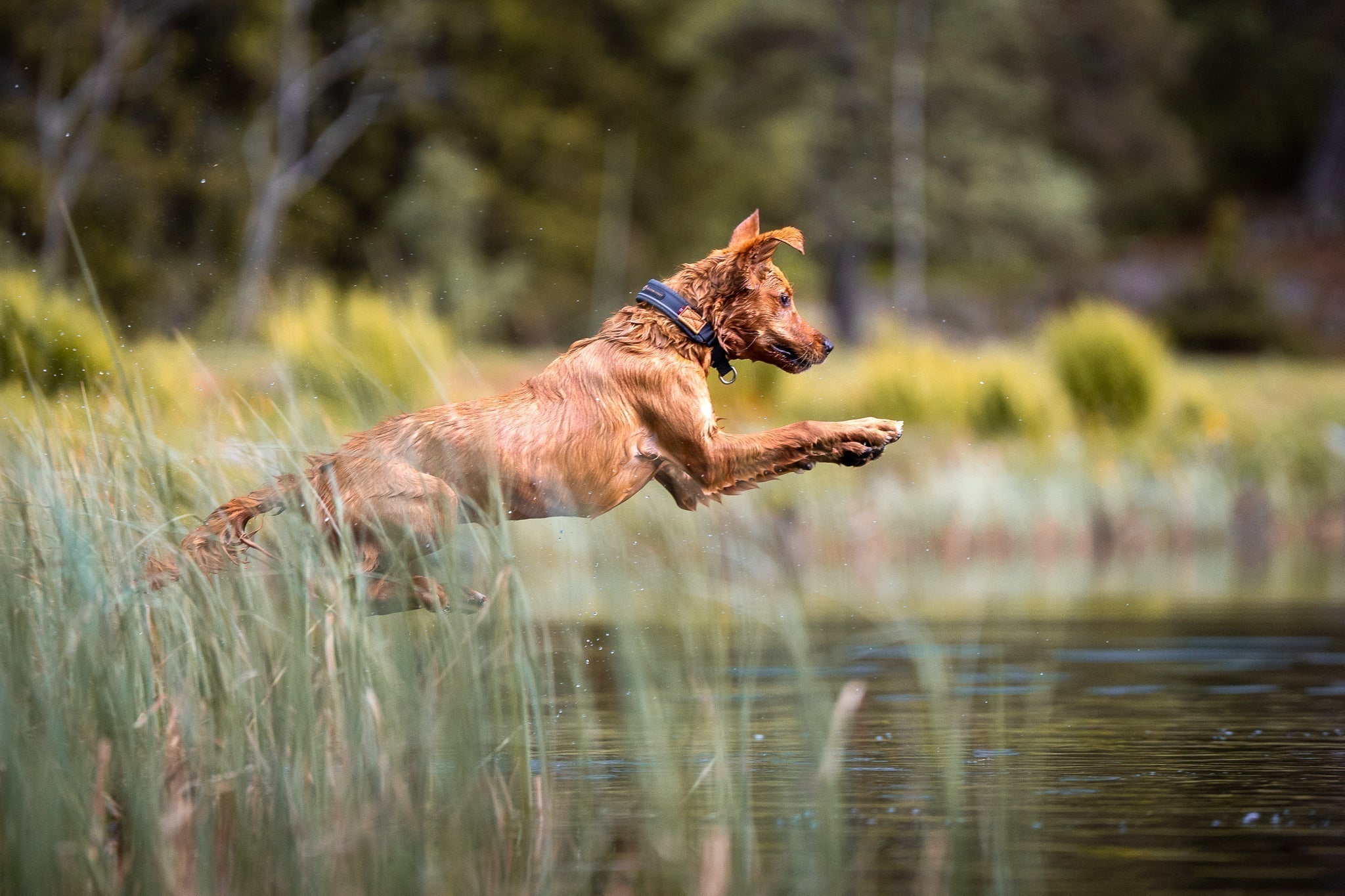
Did you know that swimming relieves pressure on a dog's skeleton and joints?
In water, dogs can move in a weightless state. They experience no pressure on their muscles or joints. Therefore, swimming is highly beneficial for all dogs, but especially for those with skeletal and joint issues, as well as overweight dogs that need to lose weight.
Swimming is, in general, excellent cardio training for dogs. In addition, the muscles around the joints are trained, particularly the chest, hip, and core muscles.
Warm and comfortable
Dogs get the best training effect from swimming in the warmest water possible. This is particularly important for dogs with muscle and skeletal ailments. Dogs that have a thick coat and are young and fit tolerate swimming in colder water better. In water that is too cold, the dog's body will use energy to maintain heat for its internal organs. This causes the muscles to become cold and lactic. In some cases, this can lead to cramps in the legs or limber tail.
 Regardless of breed and physical condition, swimming is a very effective and tiring form of exercise! One should therefore spend time making the dog comfortable with the water before starting very short swimming sessions. For a rough guide, rehabilitation therapists training healthy dogs in a heated pool might run sessions of just 2-3 minutes before a break, with a total swimming time of 8-10 minutes for the first training session, spread over several intervals.
Life jacket
A life jacket can provide great peace of mind. If you are planning to swim long distances with your dog using a canoe or other aids, you should also use one in case the dog gets cramps or something happens. If it is swimming near the water's edge, a sturdy harness may be sufficient. If a dog panics in the water, it often seeks the nearest place where it sees land. In that case, it will be much easier to get the dog out of the water by lifting it by a harness.
TRAINING EXERCISES:
If you have a dog that is confident in the water and in good, healthy shape, you can try out the exercises below. If you have a dog with health issues, you should consult a veterinarian or a canine physiotherapist to get exercises adapted to your dog's health.
What would you do?
Structure the training based on how you feel when you exercise in water. You need to be well-trained to be able to swim for half an hour straight, and to be able to swim intensive intervals at full speed many times in a row.
If there are waves, swimming can feel unsafe and strenuous. If you swim fast for a long time, your muscles simply become lactic and tired quite quickly. In that case, the dog will get a more counterproductive training effect than a constructive one. A steady and calm pace can often be wise. If your dog doesn't scratch you while you are in the water, it is excellent to go for swims together with your dog along the shore. Find the swimming method where you see the dog swimming in a concentrated and calm manner; that often provides the most effective training.
Circles
If you have a dog that is motivated by toys, you can wade out with the dog and get it to swim in both figure-eights and circles by guiding the toy around or throwing it. This is good for the dog's mobility.

High knee lifts
Wading at the water's edge is also excellent training! Throw off your shoes and wade along with your dog! It is just as good exercise in the water for us as it is for the dogs. The dog works on both balance and core muscles just by us strolling slowly at the water's edge with a little water resistance. Just keep the dog on a leash and vary between walking and trotting. Start with little water resistance before increasing gradually. This forces the dog to lift its legs properly, which helps it maintain good joint mobility.
Swimming with resistance
For well-trained dogs, you can keep the dog in a harness and a long line. Throw a toy into the water. If the dog has high motivation, you can hold it back for, e.g., 10 seconds before it is allowed to swim all the way to its toy/reward. This becomes more of an interval training, where it becomes extra strenuous for the dog when you hold it back.
 CONDITIONS ONE SHOULD BE AWARE OF IN CONNECTION WITH SWIMMING TRAINING
Saltwater poisoning
Dogs often swallow a lot of water when using a ball or retrieving other small objects, so one should use objects that are easy for the dog to pick up. If dogs swallow too much saltwater, they can get saltwater poisoning (or water intoxication) with diarrhea, vomiting, and unsteady gait. Therefore, for many dogs, it may be best to swim at a calm pace without objects. Water intoxication is usually not dangerous, but in severe cases, a veterinarian should be consulted.
Algae poisoning
Be critical when letting your dog swim in discolored water. During the summer, there is often a bloom of blue-green algae. The algae release toxins that can be life-threatening for both animals and humans. If you suspect algae poisoning, or that your dog has drunk or bathed in water with blue-green algae, you should contact a veterinarian immediately.
Limber tail (Cold tail)
For dogs that often get limber tail, you can try drying them well at the base of the tail after every swim. It is often especially important to avoid cold temperatures. Limber tail is simply muscle strain that extends to the base of the tail. This can be painful for the dog. It can last for only a few hours or many days. It often goes away on its own, but if the pain persists, you should visit a vet to get anti-inflammatory medication. Laser treatment can also have a good effect. Symptoms of limber tail include the tail often hanging straight down and appearing paralyzed, as well as the dog showing discomfort upon contact with the base of the tail.
Enjoy yourselves
Even though there are things you should be careful about if you swim your dog a lot during the summer months, this is a fantastic form of exercise in the summer heat. It is cooling for both dog and owner, and highly constructive and effective if done correctly. There are many health benefits to training in water, both for people and for dogs, whether the purpose is cardio- or strength training or just having fun together in the heat.