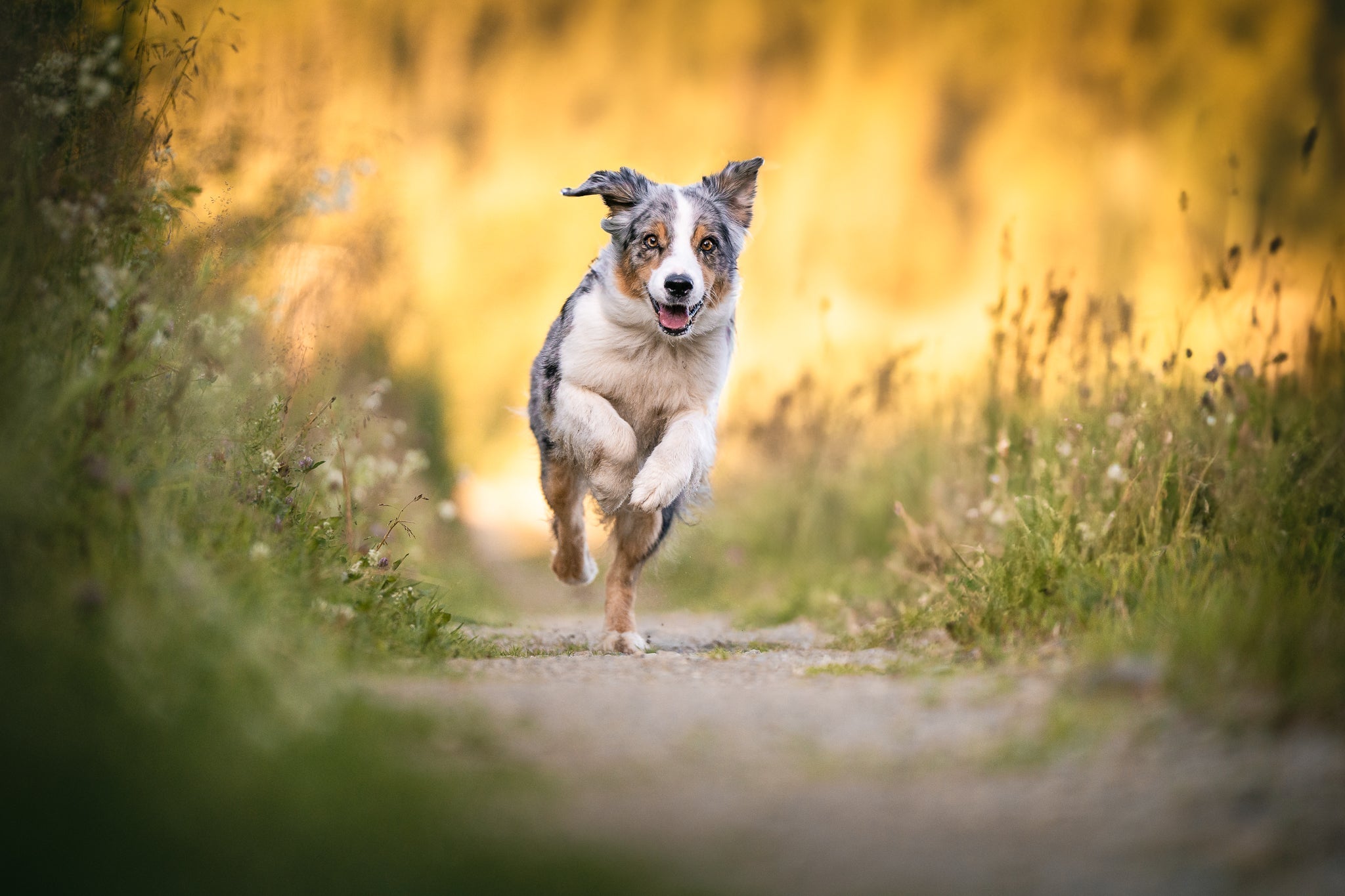
A dog deserves freedom. And to have freedom, your dog needs a good recall so that it comes when you call and does not disturb wildlife, other dogs, or people.
Much of the secret behind a good recall lies in valuable rewards, good timing when calling, and systematic training with distractions. There will also be breed-specific differences that determine how hard you need to train to get your dog to come when called. A hunting dog often has a larger radius and different interests on walks than a Labrador. It is important to know a little about your breed and its purpose in order to train with distractions that are valuable to your specific dog.
Important to remember:
- Recall is one of the most important things you teach your dog and should therefore be rewarded with the best of the best that your dog likes.
- For dogs that see toys as a reward, recall is an excellent exercise to reward with play to elicit even more speed and engagement from the dog.
- Train systematically. Do not call your dog at random. Set up an environment and create a training session for your dog with manageable distractions you know it can master. Gradually add more and more distractions to challenge and develop your dog.
Equipment:
- Long line
- Good treats/toys
- A helper

Learning:
- Say "come" (or the dog's name + come, a whistle, or cue) when the dog is right next to you. Reward immediately.
- Call "come" when the dog is one meter away from you (and not occupied with other things).
- Call "come" when the dog is 3 meters away from you.
- Gradually increase the number of meters you walk away from the dog before you call.
- Get help from an assistant who gently holds your dog back by its harness. Walk a few meters away. When the dog has full focus on you, the assistant releases the leash, and you call "come." This can also be used for the aforementioned steps if desired. This will result in a fast approach toward the owner.
- Generalize the recall word by repeating basic procedures for learning the word in various calm environments (e.g., in a parking lot, in the forest, etc.).
Use the recall word wisely
Only use the recall signal when you know the dog will come to you. If you are unsure, call something else to get the dog's attention first. The recall signal should be "sacrosanct" and only used when you know the probability is high that the dog will listen. If you are careful with this during training, you will get a significantly more solid recall. If the dog constantly learns that it doesn't have to listen as soon as you call, the recall word will eventually come to mean "I'll come when it suits me" for the dog. If the dog does not respond to your signal, you have moved too fast or there are too many distractions around; take a few steps back in your training.
 Don't be a clown
It is fine to be happy and praise clearly to reward the dog when it comes. However, it is not wise to act like a clown, shake the treat bag, and act silly for the dog to come to you. The dog should come because you have taught it that "come" means come. It should not become dependent on treat bag shaking, you jumping up and down, hooting, and acting silly to turn toward you.
Reward voluntary returns
When your dog gains more freedom and has a foundation for recall, you should reward it often for voluntarily coming in to check on you. Reward if your dog looks at you, makes contact with you, or chooses to turn away from other things in the environment to come to you. In general, you should reward a puppy or adult dog when it chooses YOU on a walk. A good relationship with your dog will also make it easier for the dog to choose you when out walking.
Systematic distractions
Bring a helper with treats. The assistant should have treats in their hand to tempt the dog. The dog must regularly get a treat from the assistant; otherwise, the assistant will lose their value. The goal is for the owner to recall the dog from someone tempting it with a treat. For over-social dogs, attention can be a large enough distraction. For the first few times, it is important that the assistant makes it as easy as possible for the dog by being mild in their temptations.
How to do it
- Keep 4-5 meters between you and the assistant.
- Let the dog go to the assistant who is squatting; let the dog sniff the treats before you call the dog once.
- Reward the dog if it comes within 5 seconds.
- If the dog does not listen, interrupt the exercise, calmly put the dog on a leash, lower the temptations by having the assistant stand passively upright, wait a little longer before you call the dog, and try again.
- Continue this training with the assistant squatting with treats in hand until the dog responds almost immediately when you call.
- Increase the temptations by having the assistant gradually tempt the dog more and more with movement, sweet-talking, and clear temptation.
- Vary between calling the dog both before it reaches the assistant and when it is right by the assistant.

Even more temptations
The procedure above can be used with other temptations such as tempting the dog with a toy, another dog, a ball, or similar. It is important that you do not tempt the dog too much. Being allowed to run to another dog, get hold of a soccer ball, or jump on people after being called by the owner will be an enormous reward for the dog. Therefore, it is wise to put a long line on the dog when training on difficult distractions. Then it will not have the opportunity to reward itself by not listening to you. Start with a relatively good distance to the difficult distractions (whether it be people, dogs, bicycles, etc.). Start at a distance where your dog is able to obey the recall signal. Gradually decrease the distance between you and the temptations.
Be creative
If you are skilled with your timing—that is, only calling the dog when you are almost certain it will come—and are creative by setting up controlled distractions, you will have a dog with an incredibly good recall. This will give you and your dog a tremendous amount of freedom in everyday life. Think carefully about what tempts your dog, and train around that. Whether it is a matter of other dogs, berry pickers, children, cows, joggers, or similar.
Teach the dog to pay attention to you
Already when you get your puppy, you should let it be off-leash as much as possible. A puppy will almost always follow you for fear of being left behind. It is important to make use of this. A dog that is never allowed to be off-leash may have an increased urge to run away as soon as it is off the leash. When you are out for a walk with your dog or puppy, you can change the direction you are walking or hide behind a bush to get it to pay more attention to you. Then it will learn that you actually do change direction sometimes, so it must pay attention to avoid being left alone.
A dog that tries to appease If you have a dog that does not come running but approaches you very slowly, sniffing, and always has to pee a little before it finally comes, it may be trying to appease you. Either because it has been scolded before when it came after you called it, or because you are irritated in your voice or your body language is threatening. Make sure the dog thinks it is pleasant to come to you.
When the dog starts coming on the recall signal, it is important to remember this:
- Coming to you should always be pleasant; it increases the dog's motivation to come when you call.
- If you see that your dog is not going to come to you, avoid calling it; instead, stand and wait or go the other way, and call when it has more focus on you.
- Feel free to call your dog 2-5 times during a walk so it doesn't associate the recall signal with being put on a leash.
- Remember not to overdo the recall training; dogs get bored too. Coming on recall should be fun and rewarding.
- It is important to maintain rewards during recall; if you are on a walk and do not have treats, and call the dog from a difficult situation, use yourself as the reward.